Pelago Revolutionizes Personalized Substance Use Disorder Support with AI-Powered AWS Solution

Healthcare organizations are navigating an increasingly complex landscape, grappling with the challenge of delivering deeply personalized patient interactions while simultaneously scaling their services to meet growing member bases. This critical balancing act often risks overwhelming dedicated care teams and potentially compromising the quality of care. In a significant development for digital health, Pelago, a company at the forefront of substance use disorder (SUD) support, has engineered an innovative AI-powered solution using Amazon Web Services (AWS) that directly addresses this dilemma. Remarkably, their engineering team conceived, built, and deployed this sophisticated system in a mere two weeks, demonstrating unprecedented agility in a highly regulated sector.
This breakthrough positions Pelago to maintain its high standard of individualized coaching and support for individuals on their recovery journeys, even as its membership expands across the United States. The core of their innovation lies in an event-driven AI assistant, leveraging AWS serverless and artificial intelligence services such as Amazon Bedrock and AWS Lambda. This system is designed to generate contextually aware suggestions for Pelago’s care team, empowering coaches with vital insights without automating the patient interaction entirely. This "human-in-the-loop" model is paramount in healthcare, ensuring clinical oversight and empathy remain central, while simultaneously circumventing the months of traditional development work and the complexities of managing intricate infrastructure.
The Pressing Challenge: Scaling Personalized Care in SUD Treatment
Substance use disorder represents a profound public health crisis globally, with significant impact on individuals, families, and healthcare systems. In the United States alone, the Substance Abuse and Mental Health Services Administration (SAMHSA) reported that nearly 48.7 million Americans aged 12 or older had a substance use disorder in 2022. Effective treatment often hinges on consistent, personalized support, including one-on-one coaching, medication management, and behavioral therapy. Pelago, as a digital clinic, provides comprehensive support for recovery from alcohol, tobacco, stimulants, cannabis, and opioid use disorders, alongside adjacent behavioral issues.
The inherent nature of behavioral health conversations is their depth and continuity. A single Pelago coach might be actively engaged with dozens of members simultaneously. Each interaction, each message sent by a coach, needs to reflect weeks or even months of prior context, personal struggles, and recovery milestones. Manually drafting such nuanced responses from scratch for multiple members, often under time pressure, is an immense burden on care teams. This manual overhead creates a bottleneck, limiting a coach’s capacity and potentially delaying critical support for members.
When Pelago’s engineering team embarked on developing an AI assistant, they confronted a multifaceted set of constraints. The primary challenge was integrating an AI that could genuinely understand and incorporate long-term conversational history. An AI assistant limited to recent messages would be largely ineffective in the context of behavioral health, where rapport and progress build over extended periods. This requirement for deep contextual understanding underscored another non-negotiable principle: human oversight. The system’s purpose was to generate suggestions for the care team, not automated responses. Every AI-generated piece of feedback had to be reviewed, evaluated, and adapted by a human coach before being communicated to a member, preserving the therapeutic alliance and clinical safety.
Adding another layer of complexity were the stringent Protected Health Information (PHI) requirements mandated by regulations such as HIPAA. All data, particularly sensitive patient information, had to remain securely within Pelago’s AWS environment, without any exposure to the public internet. This necessitated that all AI integrations operate entirely within existing Amazon Virtual Private Cloud (VPC) infrastructure, ensuring data privacy and compliance.
Beyond regulatory and clinical safety, practical operational constraints also loomed large. Coaches require immediate access to relevant information the moment they open a conversation. However, generating contextually rich content by processing dozens, or even hundreds, of prior messages through a large language model (LLM) is computationally intensive and time-consuming. Long wait times were simply unacceptable for coaches managing numerous conversations during a single shift. The engineering team was therefore tasked with delivering a solution that was not only fast and efficient but also equipped with full audit trails and robust security controls within a highly regulated environment. Their objective was clear: pre-generate contextual suggestions without impeding the user experience, all while maintaining an unyielding compliance posture.
Solution Design: An Event-Driven Serverless Architecture
To overcome these interwoven challenges, the Pelago team ingeniously adopted an event-driven serverless architecture, effectively separating concerns and optimizing workflows. The need for instant suggested responses for the care team clashed with the synchronous, real-time generation of such responses, which could block the user experience for tens of seconds due to LLM processing times. By conceptualizing each incoming member message as an asynchronous event, the system could fan out processing to independent consumers without tightly coupling them to the message delivery path. This design choice allowed for the seamless integration of new consumers, such as the AI assistant, without impacting existing components or code. Furthermore, with each processing step executed within its own AWS Lambda function, any spike in inference requests would not adversely affect message delivery or other processing operations.
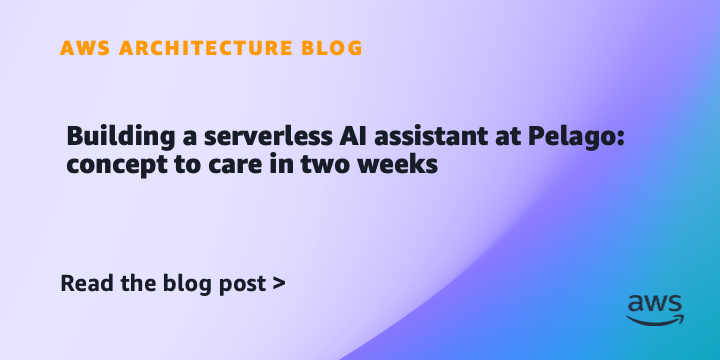
The architecture leverages Amazon Simple Notification Service (Amazon SNS) for efficient message fanout and AWS Lambda functions for processing. The workflow is initiated when a member or coach sends a message, which triggers a standardized payload publication to an SNS topic. This SNS topic then acts as a central message bus for conversation events, ensuring that a single incoming message can simultaneously trigger multiple independent processing steps.
This architectural pattern ensures that message delivery, analytics, and AI generation remain decoupled. Critically, each member’s PHI is processed separately and remains entirely within Pelago’s secure AWS boundary. This isolation means that a failure or a spike in feedback generation for one member does not disrupt or impact processing for other members, ensuring system resilience and data integrity.
A key advantage of this serverless, asynchronous approach is that inference happens in the background. Consequently, the care team does not experience delays waiting for LLM processing. Suggested messages are pre-generated, securely stored, and readily available the moment a coach opens a conversation, resulting in retrieval times consistently under 100 milliseconds, irrespective of the AI generation duration.
This serverless architecture inherently provides organic scaling capabilities. Each Lambda function automatically scales horizontally based on current traffic demands, expanding during peak usage and contracting during quieter periods, without requiring any manual pre-provisioning or scaling configuration. The addition of new event-driven downstream capabilities, such as the AI assistant itself, simply necessitates a new SNS subscription, with no modifications required to existing message-publishing or handling code, underscoring the system’s flexibility and future-proofing.
Event-Driven Fanout with Amazon SNS: The Backbone of Decoupled Processing
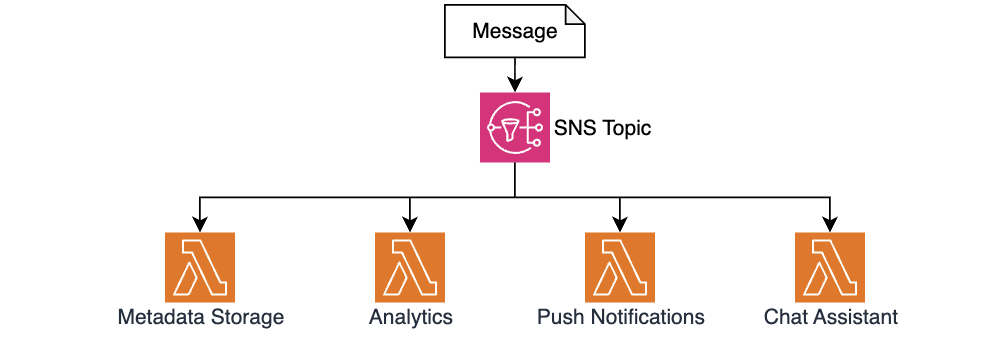
The foundation of Pelago’s chat architecture is an Amazon SNS topic, functioning as a robust message bus for all conversation events. As a fully managed pub/sub messaging service, SNS automatically delivers messages published to a topic to all subscribed consumers in parallel. This parallelism is crucial, allowing a single incoming message to initiate multiple distinct processing steps simultaneously.
When a user or coach sends a message, the system publishes a standardized JSON payload to the SNS topic, containing essential metadata such as identityId, messageId, sender, timestamp, and conversationId. SNS then efficiently delivers this event to four distinct AWS Lambda function subscribers:
- Metadata Storage Lambda: This function is responsible for writing message metadata to a MySQL database for comprehensive reporting and auditing purposes.
- Analytics Lambda: This subscriber sends relevant events to Amplitude, a product analytics platform, to gather insights into user engagement and product performance.
- Push Notification Lambda: This function triggers mobile notifications for coaches, ensuring they are promptly alerted to new messages or critical updates.
- Chat Assistant Lambda: This is the core component for the new AI functionality, generating assistant-based suggestions using Amazon Bedrock.
This sophisticated fanout pattern was instrumental in allowing the Pelago team to integrate the AI Chat Assistant feature with zero modifications to their existing message-handling code. The process was streamlined: create a new Lambda function and add it as an SNS subscription. The publisher of the message remains oblivious to the number of consumers or their specific functions, fostering an environment where new capabilities can be developed and deployed independently, minimizing the risk of regressions in the established message processing path.
Asynchronous AI Generation with Amazon Bedrock: Powering Contextual Suggestions
The Chat Assistant Lambda function is where the computationally intensive AI generation takes place. This function orchestrates a multi-step workflow designed for efficiency and accuracy.
The initial and critical step involves retrieving the complete conversation history. In behavioral health, conversations can span dozens or even hundreds of messages over several weeks or months. For the AI assistant to generate truly useful and empathetic suggestions for Pelago’s care team, it requires this entire historical context. The function queries Amazon DynamoDB for all previous messages within a given conversation. DynamoDB’s single-digit millisecond read performance ensures that even lengthy conversations (exceeding 50 messages) are typically retrieved in under 20ms, preventing bottlenecks at this crucial stage.
Following retrieval, the next step is to prepare and format the context for inference. The Lambda function transforms the structured messages from DynamoDB into a coherent conversation history format, providing Amazon Bedrock with a comprehensive narrative. This structured input allows the LLM to grasp the nuances and progression of the interaction.
Once the conversation is formatted, the Lambda function utilizes the Amazon Bedrock Runtime API to invoke Claude models. The prompt engineering is meticulously crafted, focusing heavily on empathy and validation. It guides the model to acknowledge and reflect what the member is feeling, rather than immediately jumping to advice. The prompts are also tuned to maintain contextual continuity, encouraging the model to reference earlier points in the conversation instead of treating each exchange as isolated. Furthermore, the engineering team specifically steers the model away from overly optimistic or dismissive language, ensuring suggestions are short, concise, and reflective of a text message style, aligning with the natural flow of coaching conversations within the application.
Measuring System Performance and Business Impact
The entire process, from the initial SNS trigger to the final storage of a suggestion in MySQL, typically completes in less than 4 seconds. This rapid processing time falls well within acceptable operational parameters. The tangible benefit for the care team is immediate: when a coach opens a conversation on their dashboard, the front end instantly retrieves these pre-generated suggested messages. The total response time perceived by the care team is consistently under 100 milliseconds, providing a seamless and efficient user experience.
The speed of implementation was particularly noteworthy. The Pelago team transitioned from initial technical designs to the first production deployment in an astonishing two weeks. This rapid deployment timeline included: two days dedicated to architecture and model selection in collaboration with the clinical team, three days for building the core Lambda functions, three days for rigorous integration testing and prompt refinement, and two final days for deployment and setting up comprehensive monitoring.
The system has yielded robust early results, demonstrating significant business and operational impact. From a business perspective, the average response preparation times for coaches plummeted by 40%. More importantly, internal Pelago measurements indicated that an impressive 79.6% of AI suggestions were rated as "helpful" by the care team, validating the quality and relevance of the AI’s output. Operationally, the adoption of serverless services introduced no new overhead. The team avoided managing new infrastructure, patching servers, or maintaining complex scaling configurations. The architecture also proved its resilience and scalability by successfully handling an 8x surge in message volume during a seasonal campaign, all without requiring any configuration changes, highlighting its inherent elasticity.
Implementation Details and Key Decisions for a Regulated Environment
Beyond the core architecture, the Pelago team made several critical implementation choices to meet the stringent requirements of the healthcare industry, effectively manage the application’s unique traffic patterns, and ensure system-wide reliability.
PHI Must Stay Secured: Maintaining HIPAA eligibility while utilizing advanced AI models was a paramount concern. Pelago implemented multiple AWS security features to ensure PHI never traverses the public internet. This was achieved through the use of VPC endpoints for Amazon Bedrock, ensuring that all model invocations remain securely within Pelago’s private network. The Boto3 client within the Python Lambda functions automatically routes traffic through these private endpoints. Data is encrypted at rest in both DynamoDB and RDS, all service communications utilize TLS 1.2+, and IAM policies are strictly scoped with least-privilege permissions, targeting specific resource actions and ARNs. Furthermore, audit logs of model invocations are emitted to Amazon CloudWatch, capturing only message IDs and not their content, thereby maintaining patient privacy.
Polyglot Cross-Runtime Implementation: The engineering team strategically employed a polyglot approach, using Python for Lambda functions that interact with Amazon Bedrock models. Python’s native Boto3 support for Bedrock and its simpler string manipulation capabilities made it the ideal choice for building and iterating on prompts. Conversely, the retrieval function was written in TypeScript, aligning with the majority of Pelago’s backend code and allowing for the reuse of shared libraries and Zod schemas for type-safe API contracts. This pragmatic split allowed the team to leverage the best language for each specific task without imposing a single runtime across the entire system, optimizing development efficiency and code quality.
Spiky Traffic and Pay-Per-Invocation Compute: Pelago’s application primarily serves US-based traffic, resulting in distinct diurnal patterns of message volume. Peak hours during weekday working hours can see ten times or more the volume of quieter periods. The pay-per-invocation model of AWS Lambda perfectly accommodates this spiky traffic. During a Monday morning surge, Lambda scales out automatically without any pre-provisioning. During off-peak hours, Lambda functions automatically scale down, eliminating idle compute costs. This contrasts sharply with alternative long-lived compute solutions, which would necessitate either over-provisioning for peak loads (leading to unnecessary costs) or maintaining complex auto-scaling policies that can lag during sudden spikes. With Lambda, Pelago’s solution costs are directly proportional to member engagement, with no idle cost burden.
Picking the Right Storage and Handling Idempotency: The team meticulously chose DynamoDB for conversation messages and MySQL for assistant suggestions, based on their distinct access patterns. Conversation messages demand high write throughput (exceeding 100 writes/second at peak), single-digit millisecond reads, and automatic scaling capabilities, making DynamoDB an excellent fit. Assistant suggestions, while having a lighter write load (10-20 writes/second), necessitate structured queries, foreign key relationships, and nested analytics joins, which are naturally supported by a relational database like MySQL.
To ensure system reliability and prevent redundant processing, the Chat Assistant Lambda incorporates an idempotency check. Given that SNS can deliver messages more than once, the Lambda function first checks MySQL for an existing message before generating a new one. This prevents duplicate Amazon Bedrock invocations, which would waste compute resources and could potentially surface conflicting suggestions to coaches. In instances where an Amazon Bedrock invocation fails due to throttling or model unavailability, the function logs the error without blocking the overall message flow. A built-in retry mechanism addresses transient failures, ensuring that suggestions are eventually generated even if Amazon Bedrock experiences momentary capacity constraints.
Monitoring and Observability: Comprehensive monitoring and observability were integrated from the outset. The team tracks multiple business and operational metrics using Amazon CloudWatch. CloudWatch metrics capture suggestion generation latency, enabling the team to identify promptly when model response times exceed acceptable thresholds. The retrieval rate, which measures the percentage of generated message suggestions utilized by coaches, provides valuable insights into how effectively the asynchronous timing aligns with real-world usage patterns. Additionally, the system allows coaches to rate each suggestion with a simple thumbs up or down, with these ratings stored in MySQL for future prompt tuning and model evaluation. CloudWatch alarms are configured to monitor error rates for Amazon Bedrock throttling and database connection failures, alerting the engineering team proactively before operational issues can impact the care team’s experience.
Broader Impact and Implications for Digital Health
Pelago’s swift and successful implementation of an AI-powered coaching assistant represents more than just a technological achievement; it signals a significant stride in the evolution of digital therapeutics and personalized medicine. This approach addresses several critical challenges facing the healthcare industry today:
- Scaling Personalized Care: The ability to maintain deeply personalized interactions at scale is often cited as the "holy grail" for digital health platforms. Pelago’s solution demonstrates a viable pathway to achieve this without sacrificing quality or overwhelming human care providers. This model could be replicated across various chronic disease management platforms.
- Human-in-the-Loop AI: In sensitive fields like behavioral health, trust and empathy are paramount. The "human-in-the-loop" design ensures that AI serves as an augmentative tool for clinicians, enhancing their capabilities rather than replacing them. This balanced approach is crucial for broader AI adoption in regulated industries, where ethical considerations and patient safety are non-negotiable.
- Agility in Regulated Environments: The two-week timeline for development and deployment in a HIPAA-compliant environment challenges the perception that innovation must be slow and cumbersome in regulated sectors. This case study provides a blueprint for other healthcare technology companies seeking to rapidly deploy secure, cutting-edge solutions.
- Cost-Efficiency and Operational Excellence: The adoption of serverless architecture drastically reduces operational overhead and optimizes costs by aligning compute resources directly with demand. This efficiency allows healthcare providers to invest more resources into patient care and innovation rather than infrastructure management.
- Future of Digital Therapeutics: Pelago’s model points towards a future where digital therapeutics are even more sophisticated, offering highly tailored interventions that adapt dynamically to individual patient needs, leveraging AI for deeper insights and more proactive support.
Industry analysts suggest that such innovative applications of generative AI, particularly within secure cloud environments, will become a benchmark for digital health companies. "The speed at which Pelago deployed this sophisticated, compliant solution using AWS Bedrock and Lambda is a testament to the maturity of serverless and managed AI services," stated Dr. Elena Petrova, a leading digital health technology analyst. "It showcases how specialized platforms can deliver tangible improvements in care delivery efficiency and quality, while strictly adhering to data privacy mandates."
Conclusion
The journey undertaken by Pelago from concept to production deployment vividly illustrates how small, agile engineering teams operating in highly regulated industries can successfully balance the imperative for rapid innovation with the stringent demands of compliance. Managed AI services like Amazon Bedrock, combined with the inherent scalability and security of serverless architectures, empower healthcare organizations to move with unprecedented speed and confidence.
The Pelago chat assistant stands as a compelling exemplar of what is achievable when serverless event-driven processing is harmonized with asynchronous AI generation and fast synchronous retrieval. The key patterns that underpinned this success include the strategic use of SNS fanout to decouple processing and facilitate straightforward feature additions, the proactive pre-generation of message suggestions asynchronously to eliminate care team wait times, the rigorous implementation of VPC endpoints to maintain PHI security off the public internet, and the judicious decision to leverage foundation models and prompt engineering rather than embarking on months of custom model training. This innovative approach not only addresses critical scaling challenges in personalized patient care but also sets a new standard for efficient, compliant, and empathetic digital health solutions.
Related posts: